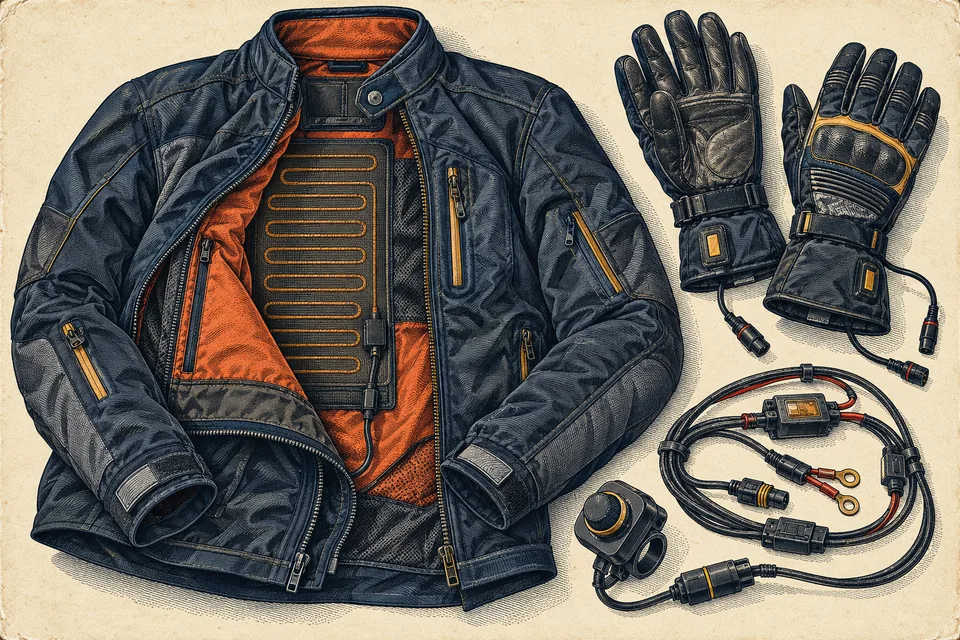
A vest, gloves and grips can collectively draw enough power to exceed what an accessory circuit can safely supply.
Magazine equipment plate · generic editorial illustration, not a product teardown or installation diagram.
Add published wattage, verify the circuit and charging capacity, and allow for idle-time operation.
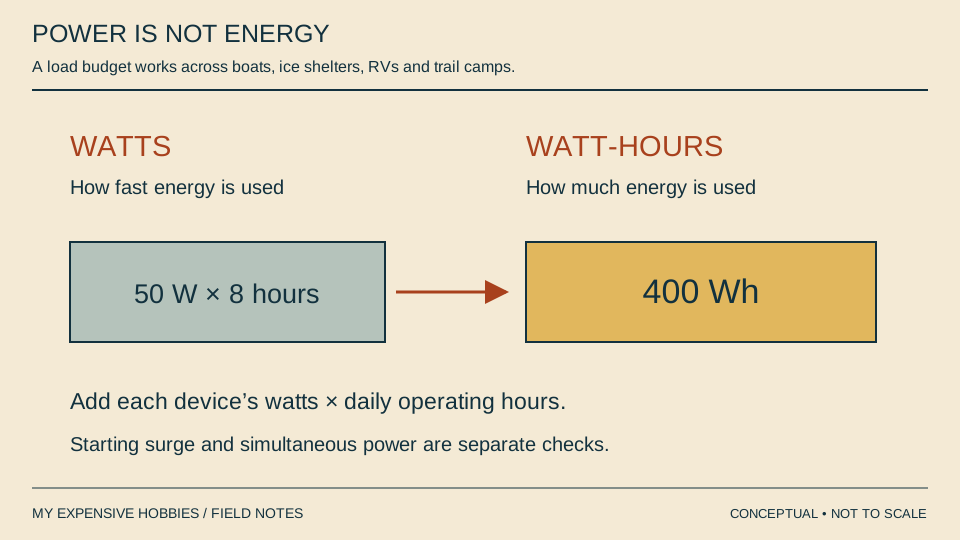
Slide the drawing sideways to read the full plate.Power is not energyPower in watts multiplied by hours gives energy in watt-hours. A 50 watt load running 8 hours uses 400 watt-hours. Add device energy for a daily budget; account separately for surge and simultaneous power.Reference: Existing calculator — electrical load planner
THE BUYING DESK · RESEARCHED OCTOBER 9, 2026
Put a real liner in the power budget
Gerbing lists 77 watts for its 12V Jacket Liner 2.0. At 12 volts that is about 6.4 amps before adding any other equipment. That concrete load is more useful than describing the garment as low-power. Your vehicle still needs enough documented accessory and charging capacity for the complete setup.
Shortlist: 3 options, selected for meaningfully different fits, budgets or system approaches. Compare the exact variant and total installed cost.
Product links currently go directly to manufacturers or retailers; we do not earn commissions from these links. How recommendations work.
Gerbing 12V Heated Jacket Liner 2.0
A vehicle-powered liner with a manufacturer-listed maximum draw of 77 watts.
Before ordering: Add gloves, grips and other accessories to the same power budget. Confirm the controller, harness and vehicle installation are appropriate.
Choose vehicle-powered heat when the available circuit, charging reserve and harness support it. If they do not, consider a separately powered garment matched to your ride length. Include the controller and connection hardware in the purchase; do not assume every pictured accessory is included.
Editorial selections based on published product information, not hands-on testing. Follow the linked specifications for the exact variant and current availability.
Fit and purchase checklist
Collect each accessory’s actual voltage and maximum watt or amp rating.
Calculate combined current as total watts divided by system voltage; use the vehicle running-voltage assumptions appropriate to your model.
Check the accessory outlet’s documented current limit and the manufacturer-approved wiring path.
Account for OEM loads, heated controls and lights that are already using charging capacity.
Look for low-voltage protection if using independent battery-powered warmers.
Use weather-resistant connectors with suitable strain relief and routing away from moving controls.
The costly mistake
A 12-volt outlet is not an unlimited electric blanket budget, however badly you want one.
Save your model, measurements and seller questions
YOUR OWN MEASUREMENTS · STORED ONLY ON THIS DEVICE