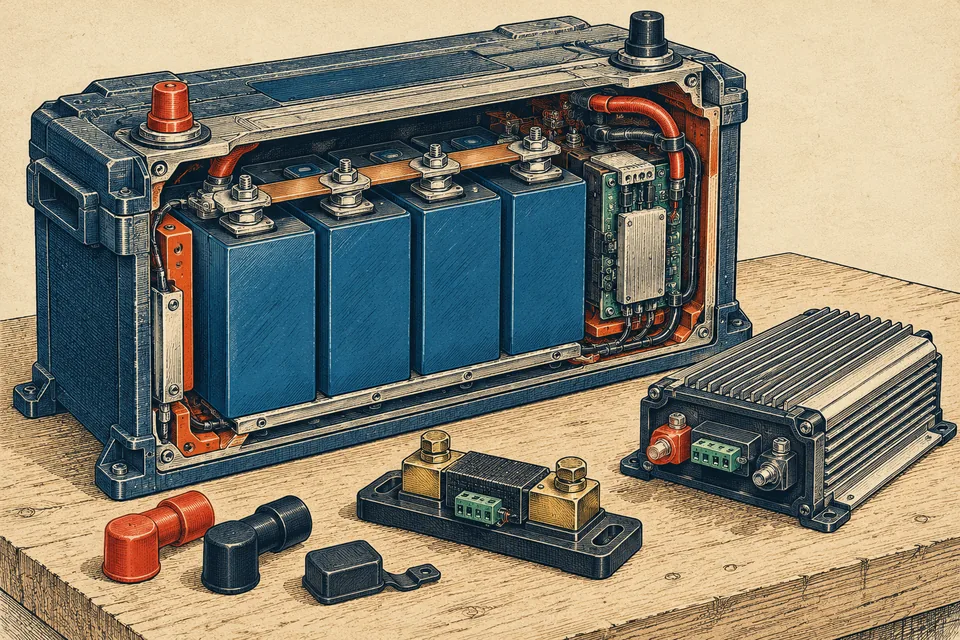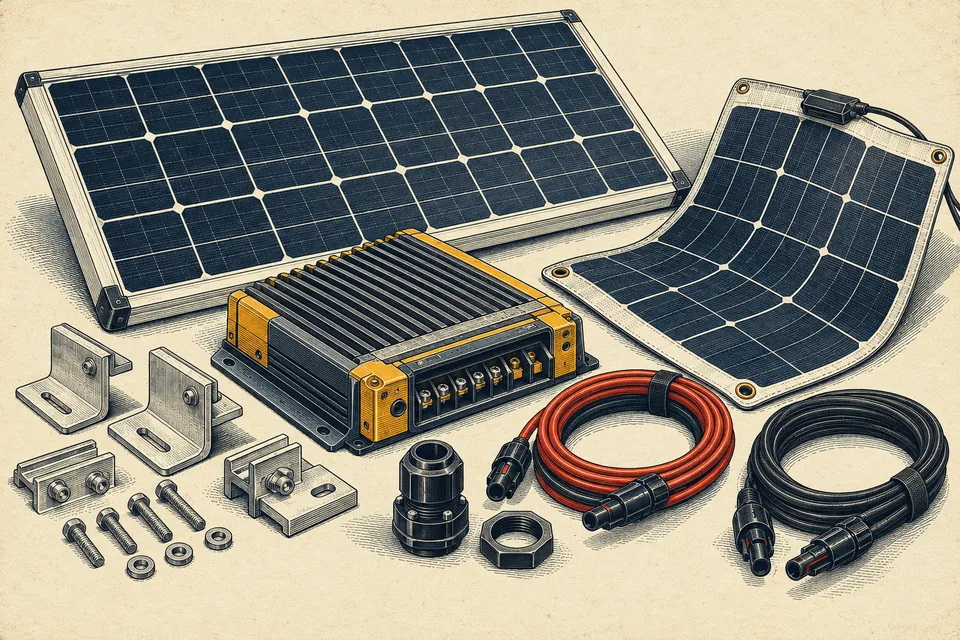
Start with daily loads, not roof area; then use realistic sunlight hours and system efficiency to estimate an initial panel size.
Start with the loads that actually run
Write each device power in watts and its estimated hours per day. A fridge that draws 45 W when the compressor runs is not necessarily a 45 W continuous load; its duty cycle depends on insulation, ambient temperature and how often it is opened. Measure or estimate that average carefully.
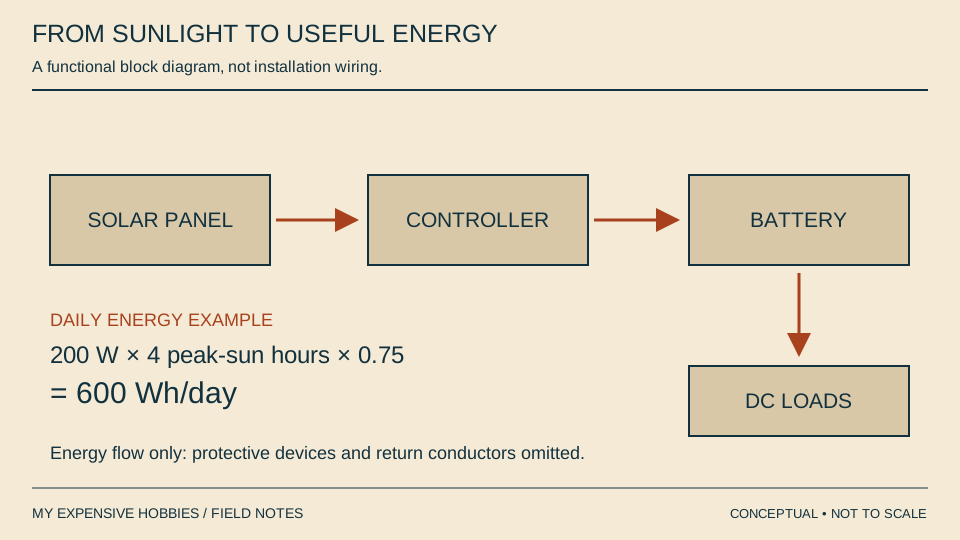
For a 600 Wh/day load, 200 W of solar and four effective full-sun hours at 75% overall yield might produce roughly 600 Wh. That does not guarantee a sunny weekend, and it does not cover a dark day.
Sunlight hours are not daylight hours
Peak-sun-hours summarize the energy of sunlight over the day into equivalent hours at a specified irradiance. Sixteen hours of summer daylight does not mean sixteen hours at rated panel output. Shade from railings, canvas, antennas and nearby trees can dramatically change real harvest.
Boats move. Consider several orientations, cloudy-day scenarios and partial shade on individual modules. Build a margin rather than making the last watt-hour do all the work.
Rigid, flexible and semi-flexible panels
Rigid panels generally ventilate their backs and can be mounted on strong brackets, but their mounts must survive wind and vibration. Flexible panels can fit shapes that rigid panels cannot; installation and heat management still matter.
No panel is truly invisible. Figure out cable routing, serviceability, impact exposure and what happens if a line snags a panel frame before ordering.
An MPPT controller is not just a black box
A controller must accept the panel array’s open-circuit voltage under the coldest anticipated conditions, handle its short-circuit current and match the bank’s chemistry and charging limits. Series panels raise voltage; parallel panels raise current. Either can be right depending on shade and wiring.
Victron names many MPPT models with PV-voltage and charging-current limits—for example, 100/30 indicates a nominal 100 V PV limit and 30 A charging limit. Always confirm the exact model datasheet and cold-weather Voc calculation.
Plan for bad weather, not just good marketing
Decide how many hours or days of low-sun autonomy you need. Then calculate the battery independently from the panels. Shore or engine charging may handle rare cloudy stretches better than trying to carpet every surface in solar cells.
Use the energy budget tool below for a first estimate, then verify hardware specifications before purchase.
FREE WORKSHEET
Solar and battery budget
Estimate daily harvest from panel watts, peak sun hours and an explicit performance factor.
Take this list shopping
- Daily average watt-hours estimated from devices and duty cycles
- Realistic peak-sun-hours range considered
- Shade and panel placement inspected
- Controller voltage/current limits matched to array
- Charge chemistry, wiring and overcurrent protection reviewed
Sources and further reading
Links are to original manufacturer documentation, authoritative boating references, or primary resources. Specific product choices still require checking current instructions.
Research published 2026-10-08. Independent educational guidance; not a certified marine engineering, electrical, mechanical or safety inspection.