Determine continuous watts, surge watts and daily energy first; treat shore power, inverters and engines as different energy sources with different safety systems.
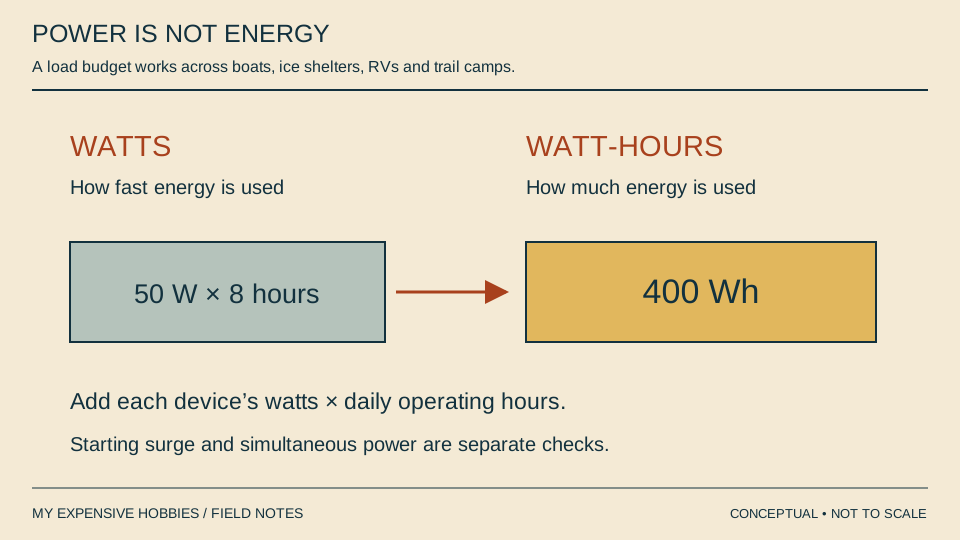
Power and energy are different constraints
Power is the instantaneous demand, in watts. Energy is how many watt-hours accumulate over time. A 1,200 W appliance for five minutes consumes about 100 Wh, but your inverter must still handle roughly 1,200 W while it runs, plus any startup surge.
The decision depends on your real loads: quiet evening lighting, compressor refrigeration, a water heater, air conditioning and cooking appliances create very different architectures.
Shore power is convenient, not casual
Marine shore inlets, cords, grounding, polarity checks and appropriate leakage protection are a system. Damaged dock pedestal wiring or a poorly designed onboard circuit can create dangerous shock hazards. Never treat an ordinary household extension cord as a substitute for a proper marine shore power installation.
Onboard AC wiring, transfer switching and electrical isolation should be designed and checked by someone qualified for marine systems, following the applicable standards and the vessel manufacturer guidance.
Inverters cannot invent electricity
An inverter trades DC battery energy for AC output with conversion losses and often a small standby draw. It can run selected AC appliances quietly, but sustained large loads may empty the battery bank rapidly. The input current on the DC side can be enormous at 12 V.
Before buying an inverter, check its continuous and surge rating, waveform, standby consumption, battery compatibility and the current your wiring must carry.
Generators add fuel, noise and exhaust
An appropriately installed marine generator can support high or sustained loads while a battery/inverter system might not. But it introduces exhaust, heat, mechanical service and carbon monoxide risk.
The U.S. Coast Guard warns that carbon monoxide can collect in surprising places on and around boats, including near swim platforms and adjacent vessels. A portable generator is not automatically a marine-safe generator just because it has a handle.
A hybrid system often makes sense
Many real installations use shore power at a dock, a modest house bank for quiet operation, and alternator or generator charging when needed. There is no universal winner—just different combinations of cost, duty cycle and convenience.
The cheapest system is often the one that correctly defines the intended loads before anyone buys a shiny inverter/charger.
FREE WORKSHEET
Onboard electrical load planner
Add common onboard appliances to estimate daily watt-hours, peak watts and baseline battery capacity.
Take this list shopping
- List AC continuous and motor-startup loads
- Calculate daily energy as well as peak watts
- Identify intended dock/anchor usage patterns
- Have AC grounding and transfer design professionally reviewed
- Include generator exhaust/CO alarm and ventilation planning
Sources and further reading
Links are to original manufacturer documentation, authoritative boating references, or primary resources. Specific product choices still require checking current instructions.
Research published 2026-10-08. Independent educational guidance; not a certified marine engineering, electrical, mechanical or safety inspection.