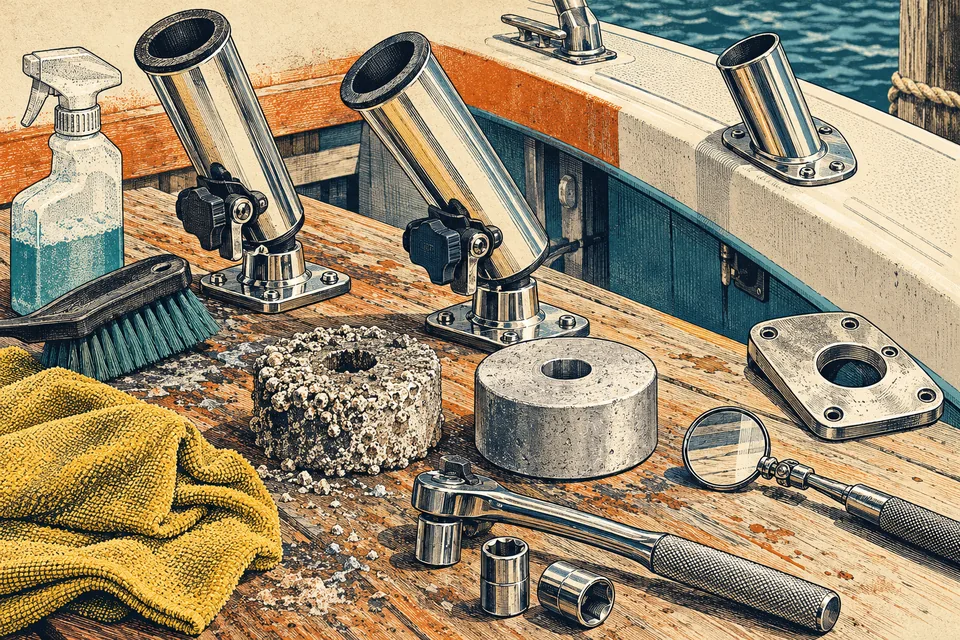
Mock up the entire motion and walking envelope before drilling; hardware backing and below-deck access can matter as much as the product choice.
Plan the actual human movement
Tape the proposed location of each mount and walk through fishing, boarding, docking and anchoring. Check that fold-up seats, hatches, coolers, trolling motors and canvas can still operate.
Keep handholds and emergency movement clear. The best-looking location may be the worst location when someone needs to move quickly.
Draw a hole-free zone
Mark fuel lines, electrical runs, tanks, buoyancy spaces and structural members below the surface. When the backside is inaccessible, do not assume a screw into thin deck skin can carry a dynamic load.
Proper backing plates and load distribution should suit the deck material and the expected force. A downrigger and a cup holder are not the same engineering problem.
Plan for water from day one
Every new hole is a future leak if the bedding and sealing system is wrong. Select compatible marine hardware, appropriate sealant and a way to inspect or service the joint later.
Avoid trapping water where it cannot drain, and protect any cut core or laminate edges as appropriate for the deck construction.
Think about future upgrades
A modular rail or track system may keep future changes from requiring new holes, but confirm that the rail, its backing and the mounting surface can accept expected loads.
Standardize fastener types and document actual spacing. The next owner—possibly you ten years later—will appreciate it.
Use a paper mockup first
Cardboard templates and painter’s tape cost less than repairing a fiberglass deck. Mock up the item’s full dimensions including handles, swing paths, rod angles and maintenance access.
Take this list shopping
- Walkway/hatch/motor clearances tested
- Under-deck utilities and reinforcement identified
- Backing structure chosen for expected load
- Drainage and waterproofing planned
- Full-scale paper template tested
Sources and further reading
Links are to original manufacturer documentation, authoritative boating references, or primary resources. Specific product choices still require checking current instructions.
Research published 2026-10-08. Independent educational guidance; not a certified marine engineering, electrical, mechanical or safety inspection.